 爱华网
爱华网Chronicle of a Death Foretold
Chronicle of a Death Foretold (Crónica de una muerte anunciada) recreates a murder that took place in Sucre, Colombia in 1951. The character named Santiago Nasar is based on a good friend from García Márquez's childhood, Cayetano Gentile Chimento. Pelayo classifies this novel as a combination of journalism, realism and detective story.
The plot of the novel revolves around Santiago Nasar's murder. The narrator acts as a detective, uncovering the events of the murder second by second.Literary critic Ruben Pelayo notes that the story "unfolds in an inverted fashion. Instead of moving forward... the plot moves backwards."[71] In the first chapter, the narrator tells the reader exactly who killed Santiago Nasar and the rest of the book is left to unfold why.
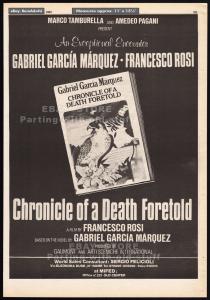
Chronicle of a Death Foretold was published in 1981, the year before García Márquez was awarded the 1982 Nobel Prize in Literature.The novel was also adapted into a film by Italian director Francesco Rosi in 1987.
This name uses Spanish naming customs: the first or paternal family name is García and the second or maternal family name is Márquez.Gabriel José de la Concordia García Márquez (/ɡɑ?r?si?? ?mɑ?rk?s/;[1] American Spanish: [ɡa?β?jel ?ar?si.a ?markes] ( listen);[2] 6 March 1927 – 17 April 2014) was a Colombian novelist, short-story writer, screenwriter and journalist, known affectionately as Gabo or Gabito throughout Latin America. Considered one of the most significant authors of the 20th century and one of the best in the Spanish language, he was awarded the 1972 Neustadt International Prize for Literature and the 1982 Nobel Prize in Literature.[3] He pursued a self-directed education that resulted in his leaving law school for a career in journalism. From early on, he showed no inhibitions in his criticism of Colombian and foreign politics. In 1958, he married Mercedes Barcha; they had two sons, Rodrigo and Gonzalo.[4]
García Márquez started as a journalist, and wrote many acclaimed non-fiction works and short stories, but is best known for his novels, such as One Hundred Years of Solitude (1967), The Autumn of the Patriarch (1975), and Love in the Time of Cholera (1985). His works have achieved significant critical acclaim and widespread commercial success, most notably for popularizing a literary style labeled as magic realism, which uses magical elements and events in otherwise ordinary and realistic situations. Some of his works are set in a fictional village called Macondo (the town mainly inspired by his birthplace Aracataca), and most of them explore the theme of solitude.
On his death in April 2014, Juan Manuel Santos, the President of Colombia, described him as "the greatest Colombian who ever lived.
爱华网www.aIhUaU.com网友整理上传,为您提供最全的知识大全,期待您的分享,转载请注明出处。